Himalayan Pink Salt Manufacturing Process: From the Mine to the Container
By the JOBAK SALT export team, Sialkot ·
How our Himalayan salt products are made, from raw rock at the Warcha Salt Mine to cartons and bags loaded into the export container, written by the team that runs the units.
Importers ask us how Himalayan pink salt is made more often than almost anything else. It is a fair question. The way a factory selects, cuts, crushes and packs the salt decides what you find when you open the container.
Below is the process as it runs at JOBAK SALT, from the rock at the mine to the sealed container. We only describe what happens in our own units, so you can hold it up against what other suppliers tell you.
Where our rock comes from
Himalayan salt is rock salt from Pakistan's Salt Range. We hold our own lease in the Warcha Salt Mine in District Khushab, Punjab. Our factory is on Rukhla Warcha Road, Qaidabad, right next to the mine, so the rock does not travel far before work on it starts.
The factory runs as two units with a combined daily processing capacity of 100 tons. Sales, export papers and buyer contact are handled from our Head Office in Sialkot. We have exported since 2018 and work with buyers in 22 countries.

Six stages, two units
Every product we make goes through the same six stages. What changes is the unit the rock goes to and what happens to it there.
| Stage | What happens | Where |
|---|---|---|
| 1. Extraction | Raw rock salt from our own lease | Warcha Salt Mine |
| 2. Selection | Rock is chosen and sorted for each product line | Mine and factory |
| 3. Processing | Cutting and carving, or crushing and grading | Unit 1 or Unit 2 |
| 4. Finishing | Polishing, fitting or sieving to the agreed specification | Unit 1 or Unit 2 |
| 5. Inspection | Checked against the order before packing | Both units |
| 6. Packing and loading | Export packing, palletising and container loading | Factory to port |
1. Extraction
It starts with raw rock salt from our lease in the Warcha Salt Mine. Because the rock comes from our own lease, we can tell a buyer exactly which mine the salt in their shipment came from.
That is also the first thing we would ask any supplier to confirm.
2. Selection and sorting
Not every block suits every product. Rock is chosen at the mine for each product line before it reaches the factory.
At the factory, blocks for bricks and tiles are sorted again by colour (pink, white or grey) and by quality. Rock for lamps goes to Unit 1 for carving. Rock for edible and bath salt goes to Unit 2 for crushing.
Natural rock varies in colour and veining, and sorting is how we match the colours you order. Edible salt comes in dark pink, light pink and white. Natural lamps up to 10 kg come in Natural Pink, White, Grey and Dark Red. Bricks and tiles come in pink, white and grey.
3. Processing in Unit 1 and Unit 2
The two units run separate processes, so rock salt products and edible salt are each handled on their own line.
Unit 1: rock salt products
Unit 1 shapes solid rock into decorative, building and wellness products. The work here is cutting and carving.
- Salt bricks and tiles: blocks are cut to the nominal size, such as 20 × 10 × 5 cm bricks or 20 × 10 × 2.5 cm tiles. Our guide on how Himalayan salt bricks and tiles are made covers sizes, finishes and wrapping step by step, so we will not repeat it here. The full size list is in our salt bricks and tiles range.
- Natural salt lamps: each one is hand-carved from a single piece of rock and keeps its natural shape. We make natural salt lamps in 16 weight bands, from 1.5–2 kg up to 200–300+ kg.
- Crafted lamps: geometric, animal shaped, 3D carved, fire bowl and basket lamps are made to set designs. Custom shapes and logos are carved to the buyer's drawing or sample. See the full salt lamps and décor range.
- Other rock salt products: wall panels, massage stones, cooking slabs and lick salt on rope.

Unit 2: edible, spa and bath salt
Unit 2 crushes, grades and packs Himalayan salt for food and wellness use, in bulk sacks and packed formats. Our edible salt is crushed, graded and packed under HACCP food safety controls.
Grading splits the crushed salt into the grain sizes buyers order:
| Range | Grain sizes | Colours |
|---|---|---|
| Edible salt | 0–1 mm, 1–2 mm, 2–5 mm, 7–10 mm, 10–15 mm and 2–5 cm chunks | Dark pink, plus light pink and white in all sizes |
| Bath and spa salt | Seven grain sizes, from 0–1 mm to 15–20 mm chunks | Dark pink and light pink |
Every grade is listed on our edible Himalayan pink salt and bath and spa salt pages.

4. Finishing
Finishing brings each product to the specification agreed with the buyer.
For bricks and tiles, that is the finish you ordered: two-side, one-side, grooved or natural edge. Geometric lamps are cut and polished smooth.
For lamps, our team fits the wooden base and then the cord set. Every mains lamp comes with a CE certified cord set with an on/off switch or dimmer, an E14 bulb holder with spring clips, and a bulb. Plugs are EU, UK, US or Australian, to suit your market.
For edible and bath salt, finishing means sieving to the agreed grain size.

5. Inspection
Every order is made to the agreed specification and checked against the order before it is packed.
What we check depends on the product. On bricks and tiles it is size and finish. On lamps it is the weight band, colour and fittings. On edible and bath salt it is grain size and colour.
Our quality system follows ISO 9001:2015, which sets out how we agree specifications with buyers, plan production and handle each order in a consistent, documented way. HACCP is applied to the handling, processing and packing of our salt. If your market needs a lab report, a PCSIR laboratory test report is available on request, with the testing charges paid by the buyer. The full list is on our quality and certifications page.
6. Packing and container loading
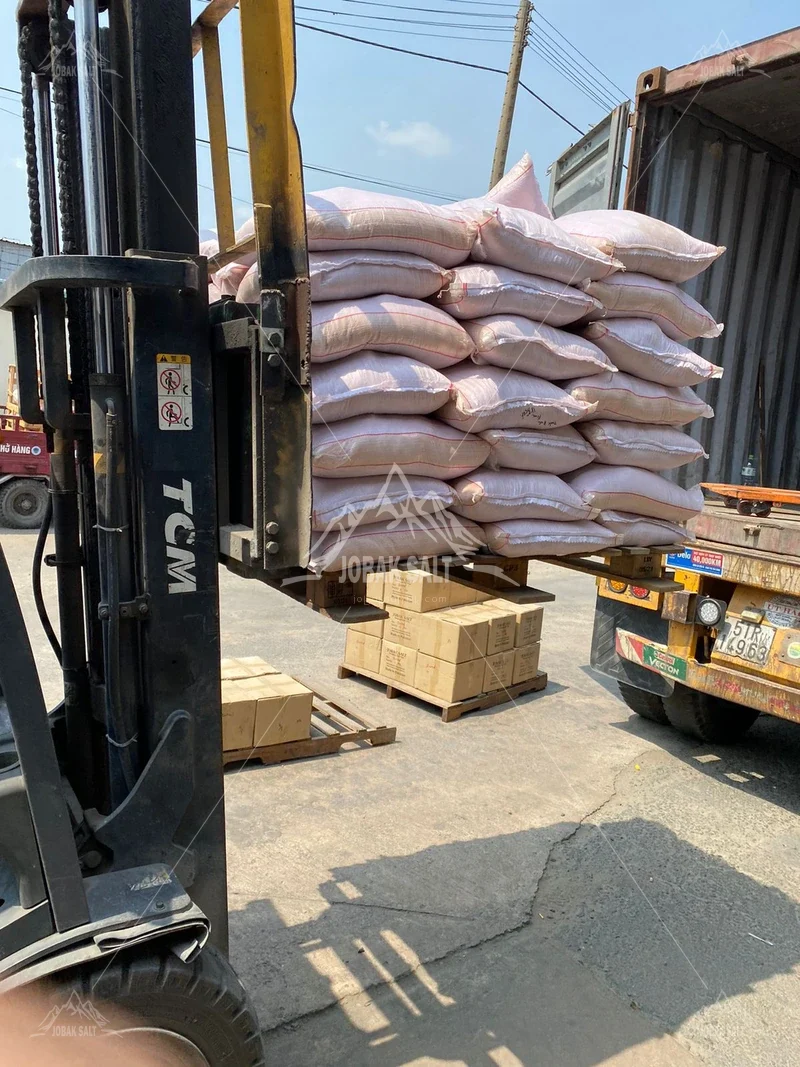
Packing is chosen for the product and the shipping method. Cartons are labelled to your requirements, with your barcodes, labels and shipping marks, then palletised and loaded.
- Salt lamps: one carton per lamp, with 2, 4 or 6 cartons in a master carton depending on size. Lamps above 10 kg ship in their own carton.
- Salt bricks and tiles: export cartons of about 24–25 kg, 48 cartons to a pallet.
- Edible, spa and bath salt: 25 kg and 50 kg bags, or your own jars, grinder bottles, pouches and bags for private label orders.
- Bulk lick salt: 1 ton jumbo bags. See our bulk lick salt range.
A 20 ft container takes a maximum of 25 tons and a 40 ft container a maximum of 28 tons, depending on the products and packing. Each pallet carries one product, but different products can share the container. The minimum order is 1 pallet.
We load at Karachi (KICT, SAPT or PICT terminal) or Port Qasim and quote FOB, CIF or EXW. Lead time depends on quantity: about 20–22 days for a 20 ft container and 25–28 days for a 40 ft container. Our container loading guide goes through load planning in more detail.
Every shipment goes with a Commercial Invoice, Packing List, Bill of Lading and Certificate of Origin. We are registered under REX, so we can make statements on origin for eligible shipments to the EU and other countries that use REX.
Questions to ask any manufacturer
Whoever you buy from, the process tells you how much control the supplier has over your order. These are the questions we would ask:
- Where does the rock come from? Ask for the name of the mine and whether the supplier has its own access to rock.
- Is there a real factory? Ask how many units there are, what each one makes and whether you can visit.
- Is food-grade salt on its own line? Ask how edible salt is kept apart from rock salt products.
- Is the specification agreed in writing? Grain size, colour, size, finish and packing should be confirmed before production starts.
- How is the order checked? Ask what is inspected before packing and which certifications cover the process.
- Which documents come with the shipment? At minimum a Commercial Invoice, Packing List, Bill of Lading and Certificate of Origin.
Our guide on how to choose a Himalayan salt supplier in Pakistan turns these into a full checklist. If you are planning a lamp range, our post on types of Himalayan salt lamps covers the whole line. For your own brand on the pack, read how to start a private label Himalayan salt brand.
You can see both units on our manufacturing page, and visits to the units near the mine can be arranged through our sales team. When your list is ready, send the products, sizes and quantities through the request a quote form.
More from us: JOBAK SALT blog · Export and buyer guides
Frequently asked questions
Can’t find your answer? Message our sales team directly.
Where does your Himalayan salt come from?
From our own lease in the Warcha Salt Mine, District Khushab, in Pakistan's Salt Range. Our factory is on Rukhla Warcha Road, Qaidabad, next to the mine.
How much salt can your factory process?
Our two manufacturing units have a combined daily processing capacity of 100 tons.
Is edible salt made on a separate line?
Yes. Unit 2 crushes, grades and packs edible, spa and bath salt, and our edible salt is produced under HACCP food safety controls. Lamps, bricks, tiles and other rock salt products are made in Unit 1.
Which certifications cover your production?
ISO 9001:2015 and HACCP. A PCSIR laboratory test report is available on request, with the testing charges paid by the buyer.
Can we visit the factory?
Yes. Contact our sales team to schedule a visit to our Head Office in Sialkot or our units near the Warcha Salt Mine.
See how your order would be made
Tell us which products, sizes and quantities you need, and your destination country. We will respond with wholesale pricing, packing options and lead times.